|
RU-486 <> The Facts
|
||
|
MOTHER'S SIDE AFFECTS IN ALL CASES:
REPORTS IN 1-2% OF CASES: 7 REPORTED DEATHS Isn't serious risk minimal since it has been reported in only 1% to 2% of the cases? Even the Population Council anticipates that the rates for hemorrhaging, hospitalization, and surgical interventions to stop bleeding will each fall into the range of one to two percent. Projecting these rates on 1.5 million abortions per year, each of these "rare" complications would effect 15,000 to 30,000 women per year. Combined with the problem of cardiac arrest, which has resulted in the death of at least one woman and heart attacks for several others, these complication rates suggest that Roussel Uclaf's decision not to market the drug in the U.S. may reflect greater concern about litigious Americans than about pro-life Americans. - Population Control and RU-486: The Hidden Agenda by David C. Reardon, Ph.D. What are the long term effects of these drugs? Long term effects of the drug have not yet been sufficiently studied, but there are reasons to believe that RU-486 could affect not only a woman’s current pregnancy, but her future pregnancies as well, potentially inducing miscarriages or causing severe malformations in later children. |
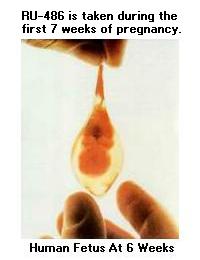
How Does RU-486 Cause An Abortion?
RU-486 blocks the action of progesterone, the natural hormone vital to maintaining the rich nutrient lining of the uterus. ____________________ Go to www.RU486facts.org |
RU-486 Suspension and Review Act
This would suspend the distribution of the drug mifepristone, commonly known as the RU-486 abortion pill, pending a review by the Comptroller General of the
US of whether the Food and Drug Administration followed proper proce- dures in approving the drug in 2000.
House Bill #H.R.1079 Senate Bill #S.511 Ask your Senators to cosponsor this bill. ____________________ US Food & Drug Administration Documents |
| But isn't taking an RU-486 pill an easy way to get an abortion?
Being a pill, RU-486 sounds like an easy way to have an abortion, when in fact, its use as an abortificient takes 3 doctor visits and a painful and risky process that takes 3 to 4 days if successful - an aborted embryo. Success rate is as low as only 90% to 95%. RU-486 DOESN'T WORK IN NEARLY 1 OUT OF 10 CASES! What is the procedure? Visit #1. RU-486, milepristone, (a pill taken by mouth) causes the uterus to shed its lining, which dislodges the embryo. Visit #2. A prostaglandin, misopostol, (pill or vaginal suppository) will be given 48 hours later. It induces contractions that expel the embryo in about 90% to 95% of the cases. It takes 3 to 4 hours to get bleeding under control. Within 24 hours after the prostaglandin, large blood clots will pass. Visit #3. About 12 to 14 days after taking RU-486, it must be determined if the abortion was successful. 5% to 10% of the cases will need a surgical abortion to remove the embryo. |
||
|
Articles, Newsclippings, Books, Websites on RU-486 from 1991 at www.ru486.org
Fall 1997
November 6, 2003
July 19, 2005
December 5, 2005
December 5, 2005
December 7, 2005
December 27, 2005
March 17, 2006 March 17, 2006 April 10, 2006 ________________________________________ |
||